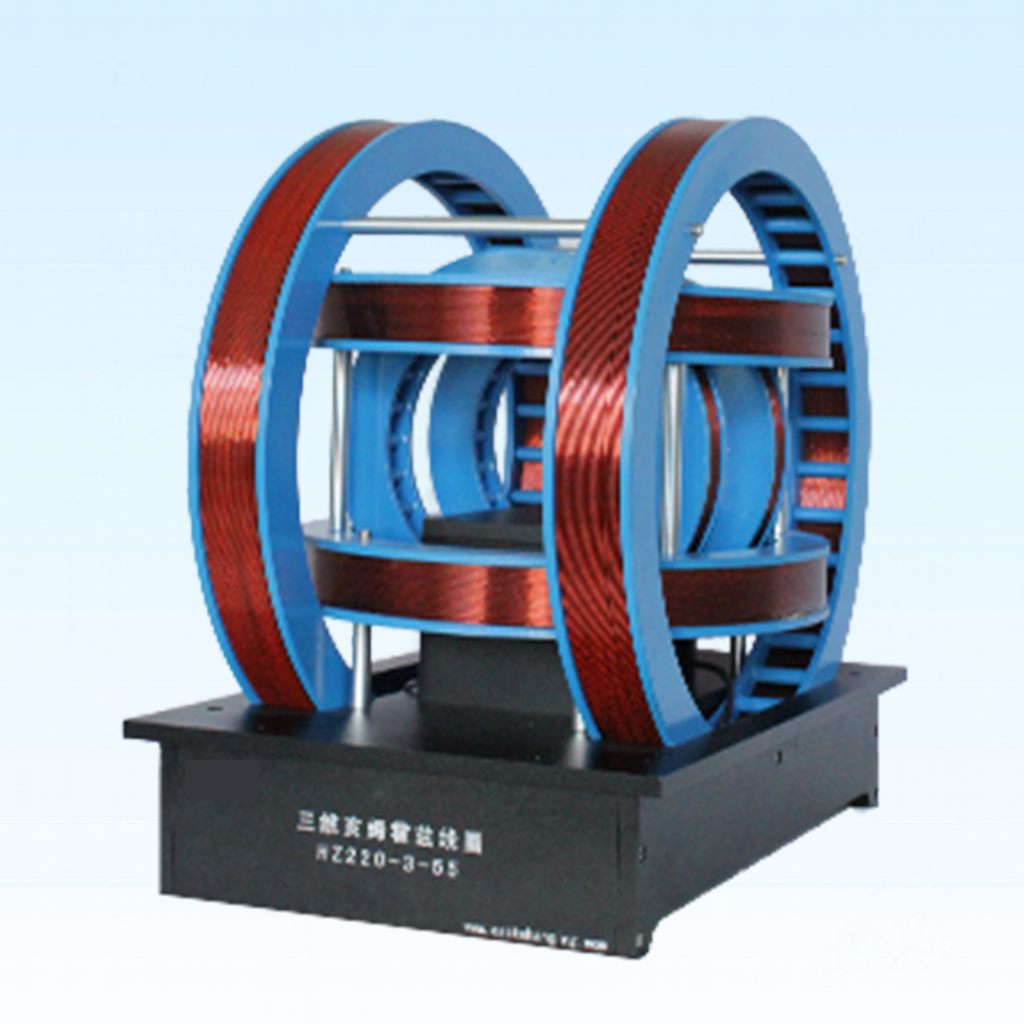
Field uniformity is one of the first figures on a Helmholtz coil specification sheet, usually a percentage plus a region — for example, ±0.1% in the central 20 mm region. It only becomes meaningful once you know what it measures and over what volume.
This guide explains what the percentage means, what the central region is, why the field is most uniform at the centre, and why it matters — plus how to compare specifications.
What “±0.1%” actually means
Uniformity describes how much the magnetic field varies from place to place inside a stated volume. A figure of ±0.1% means that, within that volume, the field at any point deviates from the field at the centre by no more than 0.1% of the central value, in either direction.
The percentage is a limit on variation, not a measure of field strength: it says the field stays within 0.1% of its own central value across the stated region. Uniformity is always a paired statement: a deviation figure plus the volume it applies to.
The central 20 mm region
The “central 20 mm region” is the volume around the centre of the coil pair over which the ±0.1% figure holds. The device under test should sit inside this volume. A sensor larger than the region, or placed partly outside it, will see a field that varies more than the headline figure suggests.
That is normal for a precision specification: it covers the best-controlled part of the field, not the whole space between the coils. If the sensitive volume is larger, discuss a larger coil diameter or a wider gap distance — both are customizable.
Why the field is most uniform at the centre
A Helmholtz pair is two identical coils on a common axis, separated by a distance equal to their radius. The fields of the two coils combine to cancel the first-order variation of the field along the axis, so near the centre the field changes only slowly with position.
Move away from the centre, and the cancellation becomes less exact: the field from each coil falls off with distance and the balance between the two shifts, so the field differs more from the central value. Uniformity degrades gradually with displacement, rather than switching off at a sharp boundary.
Why uniformity matters
It matters for calibration, simulation, and compensation alike.
Sensor calibration
When you calibrate a magnetic sensor, you expose it to a known field and record its output. If the field varies across the sensing element, different parts see different fields and the calibration mixes those values together.
Magnetometer testing
A magnetometer test is only meaningful if the field at the sensing location is known. In a non-uniform field, a small positioning error changes the field the instrument sees — an error indistinguishable from an error in the instrument itself.
Field compensation
In field compensation, a Helmholtz coil generates a field that cancels an unwanted background field, such as the ambient field in a laboratory. Compensation only works if the cancelling field matches the background field over the whole volume that needs shielding.
How to read a uniformity specification when comparing coils
Do not compare percentages alone. A tighter percentage over a smaller region is not the same as a looser percentage over a larger one, and neither is automatically better. What matters is whether the figure covers the volume your device actually occupies, at the uniformity your measurement needs.
| What to check | Why it matters |
|---|---|
| The uniformity figure | Maximum deviation from the central value. |
| The region it applies to | The volume it holds over — here, the central 20 mm region. |
| Your device size | The sensing volume must fit inside it, with margin for positioning. |
| Your accuracy need | Whether the deviation is small enough for your measurement. |
Check in that order: first confirm the uniform region is large enough for your device, then check whether the percentage is tight enough for your measurement. If the standard region is too small, ask whether a larger coil diameter or a different gap distance can widen it.
1D, 2D, and 3D configurations
Helmholtz coils are available in 1D, 2D, and 3D configurations. A 1D system uses one coil pair on a single axis, suiting work where the field only needs to point in one direction. A 2D system adds a second pair on a perpendicular axis, so the field can be directed anywhere in a plane; a 3D system adds a third pair, giving full control of the field direction in space.
The number of axes does not change the meaning of the percentage. A 3D system can rotate the applied field around a stationary sensor, while a 1D system requires the sensor itself to be turned.
What supports stable uniformity in practice
A uniformity figure describes the field geometry, but the field in a real coil also depends on how it is built and driven. The coils use oxygen-free copper or enameled copper wire, and the coil frame is a non-magnetic aluminum alloy, so the structure itself does not distort the field. The power supply is a high-precision constant current source, which keeps the field steady; control is closed-loop or open-loop via a software interface, and cooling is air-cooled or water-cooled.
Frequently asked questions
What does “±0.1%” mean for a Helmholtz coil?
It means the field at any point inside the stated region deviates from the field at the centre by no more than 0.1% of the central value.
What is the central 20 mm region?
It is the volume around the centre of the coil pair over which the ±0.1% figure holds. Your sensor or sample should sit inside it; outside it, the deviation exceeds 0.1%.
Why is the field less uniform away from the centre?
Near the centre, the two coils balance and cancel first-order field variation. Away from the centre the balance becomes less exact, so the field changes more rapidly with position.
Is a smaller uniformity percentage always better?
Not on its own. A tighter percentage over a smaller region may suit a tiny sensor and fail a larger one. Compare the percentage and the region together.
Do I need a 1D, 2D, or 3D coil?
Choose 1D for one axis, 2D for any direction in a plane, and 3D for any direction in space.
Inquiry checklist
Have the following ready before you ask for a quotation.
- Required uniformity: the maximum field deviation your calibration or test can accept.
- Size of the volume that must stay uniform: the dimensions of your sensor or sample, plus positioning margin.
- Axes needed: 1D, 2D, or 3D.
- Field range: the field strengths you need, so coil diameter, gap distance, and field range can be matched to the application.
- Cooling available: whether air cooling is sufficient or water cooling is needed.
- Control preference: closed-loop or open-loop control via the software interface.
For the full product specification, see the Helmholtz Coil product page. If you are still deciding on size and configuration, the sizing guide How to Select a Helmholtz Coil.