A gaussmeter and a fluxmeter answer different questions. A gaussmeter tells you how strong the magnetic field is at one point. A fluxmeter tells you how much total magnetic flux passes through a coil or a magnet assembly. Confusing the two is a common mistake when specifying an instrument. This guide explains the physics, when to choose which, and what each one cannot do.
What a Gaussmeter Measures
A gaussmeter measures magnetic flux density, symbol B, at a point — how concentrated the field is at that exact location, expressed in tesla (T) in SI units, or in gauss (Gs), where 1 tesla equals 10,000 gauss. It gives a local value: the field here, at this probe position, in this direction.
Most gaussmeters use a Hall probe: a small semiconductor element at the probe tip. A magnetic field through it produces a small voltage, the Hall voltage, proportional to the flux density perpendicular to the sensor, which the instrument converts into a field reading in tesla or gauss. Because the sensing element is small, the probe can sit close to a magnet surface, inside a narrow gap, or at a defined distance from a sample.
That point-by-point character is the gaussmeter’s strength. Moving the probe across a surface or through a gap maps how the field changes, finds the strongest and weakest points, and compares magnets under the same probe position.
What a Fluxmeter Measures
A fluxmeter measures magnetic flux, symbol Φ (phi): the total magnetic field passing through a given area, expressed in weber (Wb). Where a gaussmeter asks “how strong is the field at this point?”, a fluxmeter asks “how much flux in total passes through this coil?”
A fluxmeter works by induction testing, with a search coil of known area and number of turns around a magnet or inside a magnetic circuit. When the flux through the coil changes, a voltage is induced — Faraday’s law of induction. The fluxmeter integrates that voltage over time, giving the change in total flux linked by the coil.
A fluxmeter therefore measures a change in flux, not a steady point value. In a typical test the magnet is inserted into the coil, removed from it, or the coil is moved relative to the magnet, and the instrument records the flux change: a single number describing the whole magnet or assembly, used for checking complete magnets, comparing batches, and pass/fail testing.
Gaussmeter vs Fluxmeter at a Glance
| Aspect | Gaussmeter | Fluxmeter |
|---|---|---|
| What it measures | Magnetic flux density B at a point | Total magnetic flux Φ through a search coil |
| Quantity and unit | Flux density, in tesla (T) or gauss (Gs) | Flux, in weber (Wb) |
| Typical use | Point-field mapping, calibration checks, weak-field and geomagnetic checks | Total flux of a magnet or assembly, high-speed pass/fail induction testing |
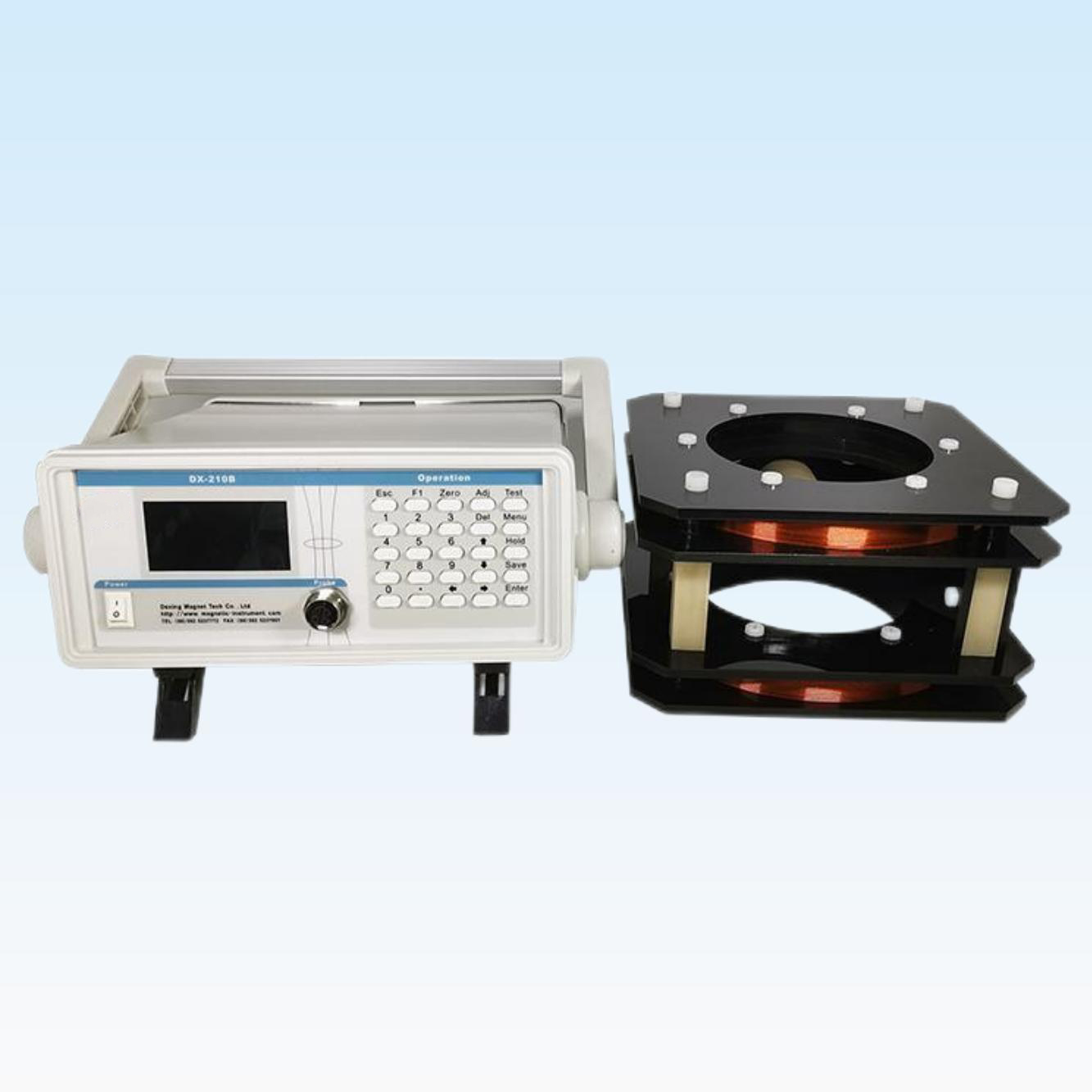
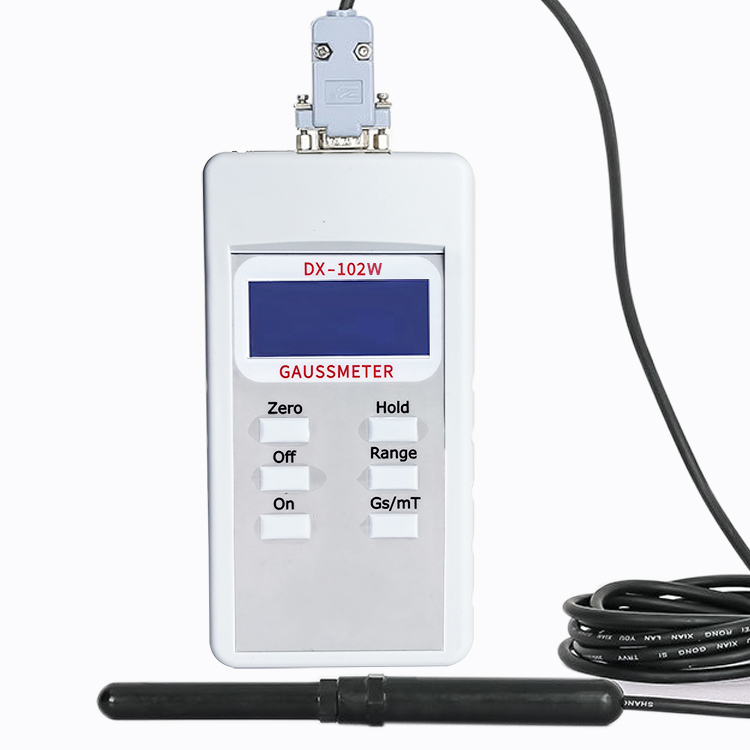
| Example product | Handheld Gaussmeter — weak DC fields and geomagnetic signals; ranges 0–3 Gs / 30 Gs / 300 Gs; sensitive probe; peak hold, unit switching, auto-zeroing; digital signal processing | CMT-210B Fluxmeter — magnetic flux by induction testing; high-speed testing; fast response; reliable data capture |
When to Choose a Gaussmeter
Choose a gaussmeter when the field at a specific point is what matters: mapping the field across a magnet’s pole face, checking an electromagnet gap, verifying uniformity across a working area, or measuring weak DC fields and geomagnetic signals. If your specification is a field value at a defined position, a gaussmeter reports exactly that quantity.
- You need the field value at a defined point, not a total for the whole part.
- You need to map how the field varies across a surface, along a gap, or around a device.
- You are checking weak DC magnetic fields or geomagnetic signals.
- You are verifying a field source at a known probe position.
When to Choose a Fluxmeter
Choose a fluxmeter when the total flux of a magnet or assembly is what matters: checking the total flux of a finished magnet, comparing magnets from different batches, or running pass/fail induction testing on a production line, where a single flux value decides whether each part passes. If your specification is a total flux value, a fluxmeter measures that total directly.
- You need the total flux of a magnet or assembly, not the field at one spot.
- You are running pass/fail induction testing on finished parts.
- You need high-speed testing on a production line.
- You are comparing production batches by a single flux value per part.
What Each Instrument Cannot Do
Neither instrument can replace the other. A gaussmeter cannot give the total flux of a magnet from a single reading: a point measurement is only the field at that point, and a strong spot does not guarantee that the total flux is correct. A fluxmeter, in turn, cannot tell you where the field is strong or weak: it returns one total for the whole coil, so a local defect has no location in the result. It also measures a change in flux linked by the search coil, not a steady field at a point, so how the magnet and the coil move relative to each other is part of the measurement. Choosing the wrong instrument gives a different physical quantity from the one your specification asks for.
The Two Instruments in This Guide
The Handheld Gaussmeter measures point fields: weak DC magnetic fields and geomagnetic signals, with three measurement ranges, 0–3 Gs, 30 Gs, and 300 Gs, a sensitive probe, peak hold, unit switching, and auto-zeroing, with digital signal processing. The CMT-210B Fluxmeter measures total flux by induction testing, built for high-speed testing, with a fast response and reliable data capture for production testing.
Inquiry Checklist
Before asking for a quotation or a recommendation, have the following ready — the choice depends on these answers.
- What you need to measure: a point field value, or the total flux of a magnet or assembly.
- Your field range, or your expected flux range.
- The size of your sample or magnet, and of the gap or working area.
- Your test speed: a single laboratory check, or repeated high-speed production testing.
- How the result will be used: mapping, calibration, specification check, or pass/fail testing.
Frequently Asked Questions
Can a gaussmeter measure total flux?
No. A gaussmeter measures flux density at a point. A total flux value needs a fluxmeter with a search coil.
Can a fluxmeter measure the field at a point?
No. A fluxmeter returns a single total flux value for the coil; it cannot map the field across a surface.
Which instrument is used for pass/fail testing of magnets?
A fluxmeter is the usual choice. It gives one total flux value per part by induction testing, which can be compared with a pass/fail limit, and it suits high-speed testing.
Which instrument is used to check a weak DC field or a geomagnetic signal?
A gaussmeter is the usual choice. The Handheld Gaussmeter measures weak DC magnetic fields and geomagnetic signals, with ranges of 0–3 Gs, 30 Gs, and 300 Gs.
Do I need a search coil with a fluxmeter?
Yes. The coil is placed around the magnet or inside the magnetic circuit, and the fluxmeter integrates the voltage induced in it when the flux changes.