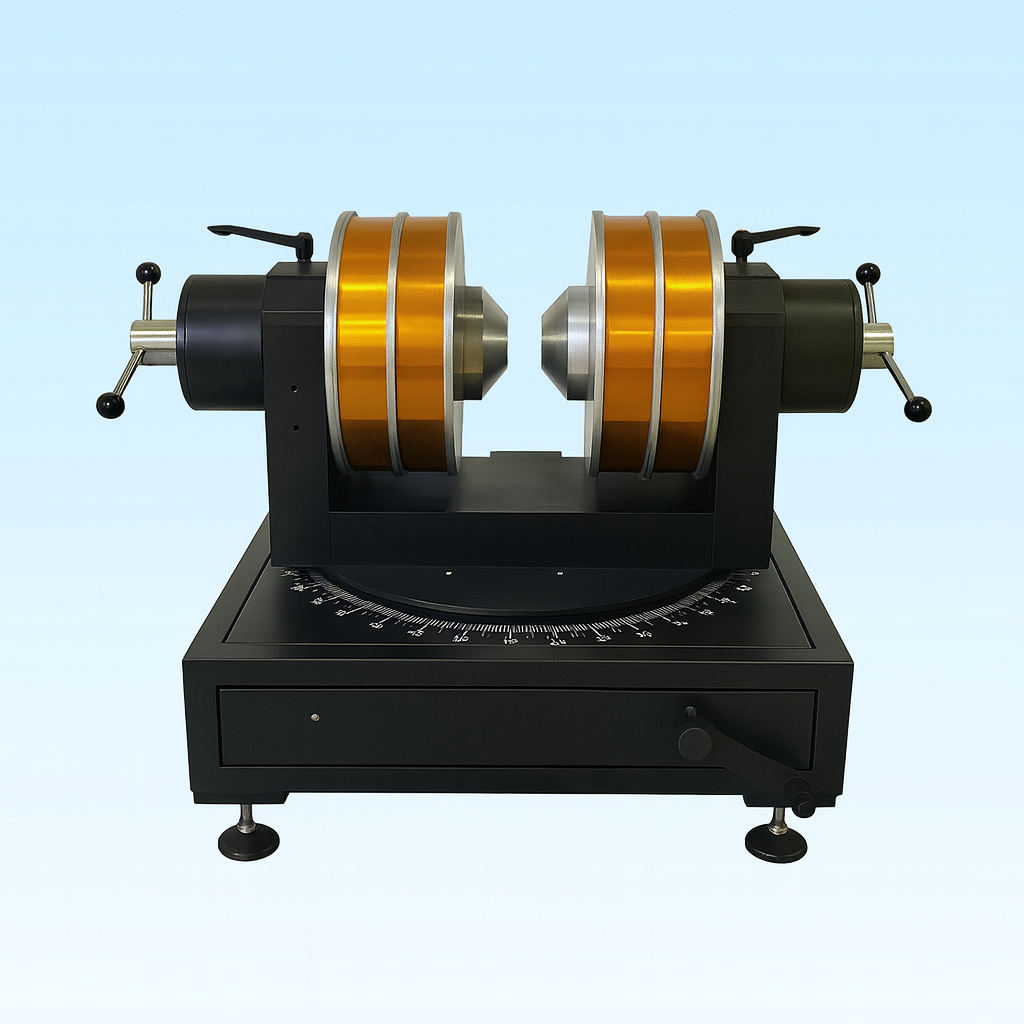
Choosing an electromagnet starts with two numbers: the magnetic field you need and the air gap at which you need it. A magnet strong across a narrow gap may be wrong for a larger sample. All field values here are published EM Series values at a 20 mm gap. The models are EM1, EM3, EM4, EM4W, EM5, and EM7, each with a matched bipolar power supply.
Why the field falls as the air gap widens
An electromagnet is a magnetic circuit. Current in the coil drives flux through the iron yoke and pole pieces, across the air gap, and back through the yoke. Air has a much higher magnetic reluctance than iron, so the gap dominates the circuit: as it widens, reluctance rises, flux falls, and the field falls with it.
The fall is not linear, and leakage flux grows as the poles move apart. A field value without a stated gap is not a specification, and extra current helps only until the iron saturates. Always compare field at the gap you will use.
How to read the selection table
Start from your experiment, not the largest model. Write down the field, the gap, and the volume over which the field must be uniform, then find the smallest model meeting all three. If none does, change the fixture, holder, or gap first.
The table gives the published field at a 20 mm gap: a reference point, not a promise at every gap. A model reaching at least 0.83 T at 20 mm produces less at 50 mm, and a 0–50 mm model cannot be used at 80 mm. Check gap range first, then field, then uniformity. All gap ranges are continuously adjustable and bi-directional.
| Model | Gap range (mm) | Field at 20 mm gap | 1% uniformity region at 20 mm gap | Cooling | Weight (kg) |
|---|---|---|---|---|---|
| EM1 | 0–50 | at least 0.21 T | φ5 × 6 mm | Natural air | 6.5 |
| EM3 | 0–64 | at least 0.65 T | φ20 × 20 mm | Natural air | 45 |
| EM4 | 0–100 | at least 0.83 T | φ30 × 18 mm | Natural air | 130 |
| EM4W | 0–88 | at least 1.5 T | φ30 × 18 mm | Water | 138 |
| EM5 | 0–129 | at least 1.8 T | φ30 × 20 mm | Water | 280 |
| EM7 | 0–168 | at least 2.2 T | φ40 × 18 mm | Water | 565 |
The trade-off is visible: the widest gaps and highest fields come with the greatest weight and water cooling. EM4W has a narrower range than EM4, 0–88 mm against 0–100 mm, but reaches at least 1.5 T at 20 mm, against at least 0.83 T for EM4, because water cooling allows higher continuous current.
Pole size and field uniformity
The field is strongest and most uniform near the centre of the pole faces, falling off away from the centre at a rate that depends on pole size and gap. A larger pole gives a larger uniform region, which matters once the sample is more than a few millimetres across.
Pole size is 38 mm for EM1, 76 mm for EM3, 100 mm for EM4 and EM4W, 127 mm for EM5, and 178 mm for EM7. Pole tip size is 25 mm, 40 mm, 50 mm, 50 mm, 60 mm, and 76 mm in the same order. The 1% uniformity region at a 20 mm gap grows from φ5 × 6 mm for EM1 to φ40 × 18 mm for EM7, with EM3 at φ20 × 20 mm, EM4 and EM4W at φ30 × 18 mm, and EM5 at φ30 × 20 mm.
Read uniformity as you read field: it applies at the stated gap. If you need a uniform field over a 20 mm sample, EM1 is not suitable, because its 1% region at 20 mm is only φ5 × 6 mm. Pole dimensions are customizable.
Air cooling vs water cooling
Cooling decides what the magnet can do continuously: EM1, EM3, and EM4 use natural air cooling; EM4W, EM5, and EM7 use water cooling. Input power is 100 W for EM1, 250 W for EM3, 350 W for EM4, 2400 W for EM4W, 3500 W for EM5, and 5400 W for EM7. Maximum continuous current is ±4 A, ±6 A, ±20 A, ±55 A, ±70 A, and ±85 A in the same order. DC resistance at 20 °C is 3.6 Ω, 4.5 Ω, 0.65 Ω, 0.65 Ω, 0.68 Ω, and 0.65 Ω.
Air-cooled models are simpler to install, with no water lines, chiller, or leak checks, and suit teaching labs, small benches, and short sessions. Their limit is continuous heat: at full current the coil heats up and the field drifts. Water flow is 8 L/min for EM4W and EM5 and 12 L/min for EM7, at 300–600 kPa and an inlet temperature of 15–20 °C; confirm your lab can supply that continuously. In return, water cooling supports much higher continuous current and more stable temperature during long measurements.
Weight, size, and installation
Weight rises steeply: 6.5 kg for EM1, 45 kg for EM3, 130 kg for EM4, 138 kg for EM4W, 280 kg for EM5, and 565 kg for EM7. EM1 can be moved by hand; EM3 needs two people or a trolley. From EM4 upwards, plan for a crane, hoist, or forklift, a floor or table that carries the load, and clear space to move the magnet without striking the poles, since a dent or chip changes the gap and the field.
Mounting is horizontal or vertical, and should follow the experiment: a vertical gap suits a sample that hangs or is lowered into the field, a horizontal gap a sample stage, an optical table, or a cryostat approaching from the side. Accessories include an electric or manual rotating stage and an optical support; decide orientation and accessories before ordering.
Frequently asked questions
Can I use the field at 20 mm to estimate the field at my gap?
Only as a rough guide: the exact curve depends on pole geometry, the yoke, and the current. Use the 20 mm value to shortlist models, then confirm the field at your actual gap.
Is the largest model always the safest choice?
No. A larger model costs more, weighs more, needs water cooling, and needs more space and handling. If a smaller model meets your field, gap, and uniformity needs together, it is the better choice.
Why does uniformity matter if I only measure at the centre?
Most samples have a finite size, and probes and holders occupy space too. If the field varies across that volume, different parts of the sample see different fields. A stated 1% region tells you how large that volume can be before the variation matters.
Inquiry checklist
Have these details ready before you ask for a quote:
- Required field, and the air gap at which it is required.
- Gap range needed, including the largest gap your sample or fixture requires.
- Sample size and the uniformity region needed over that volume.
- Cooling available: natural air, or water at the required flow, pressure, and inlet temperature.
- Mounting orientation: horizontal or vertical.
- Accessories needed, such as an electric or manual rotating stage or an optical support.
- Power supply and control requirements, and the space, floor loading, and handling available for installation.
See the Standard Electromagnet EM Series product page.